Suburban properties across master-planned communities like Cinco Ranch, Elyson, and Firethorne regularly encounter severe imported red fire ant pressure due to dense clay loam soils and high water tables near local…
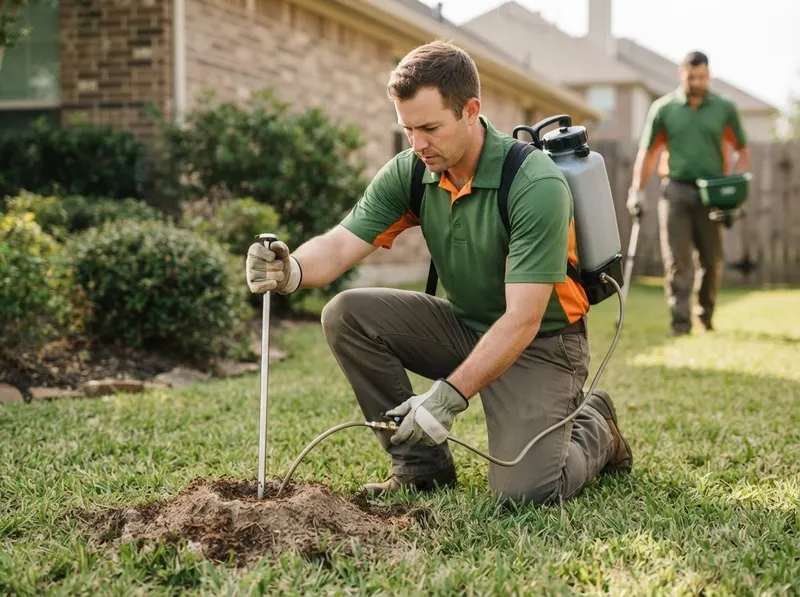
Suburban properties across master-planned communities like Cinco Ranch, Elyson, and Firethorne regularly encounter severe imported red fire ant pressure due to dense clay loam soils and high water tables near local drainage bayous. Broad-spectrum surface sprays often fail because they scatter worker ants into satellite colonies across the turf rather than eliminating the reproductive queen. Specialized colony inoculation uses targeted, low-toxicity insect growth regulators that foraging worker ants carry deep into subterranean galleries, sterilizing the queen and collapsing the nesting network within 10 to 21 days. This approach avoids toxic chemical runoff into stormwater swales while keeping family lawns safe for young children and domestic pets.
Decision guidance depends directly on turf surface conditions and perimeter architecture. If an active colony is tunneling through lawn soil adjacent to outdoor living areas, slow-acting biological inoculation is the appropriate choice to neutralize the colony systemically without sparking territorial defenses. Conversely, if ants have penetrated brick weep holes or expansion joints along concrete foundations near patio doorways, localized contact barriers provide rapid structural protection while systemic granular baits work through the remaining turf. The trade-off involves prioritizing deliberate queen sterilization over immediate contact-kill knockdowns that leave surviving subterranean queens intact.
Properties in Cane Island, Grand Lakes, and WoodCreek Reserve often border open reserve acreage where fire ants repeatedly migrate following heavy Gulf Coast rainstorms. Soil saturation forces colonies out of subterranean burrows and into visible surface mounds around irrigation heads, sidewalks, and foundation perimeters. Initial remediation begins with a structured 3-step biological treatment process: 1. A physical yard grid search identifies active brood nests and perimeter entry gaps. 2. Granular colony inoculants are applied directly around mound perimeters during active foraging windows. 3. Foundation weep-hole seals are verified to block interior migration into wall voids.
Every job gets a firm, written price after a free on-site visit.
Tell us about your fire ant lawn management & colony inoculation job in Katy and we'll send a clear, written quote, usually the same day.
 Lone Creek Pest Control